
Overview
Successful Removal of Hazardous VOCs
Using our proprietary in-situ remediation technology, we successfully removed hazardous VOCs, including Benzene and 1,2-Dichloroethane. While a universal remediation method remains unestablished in 2025, this case study presents a breakthrough solution to existing technical challenges, setting a new standard for future environmental safety.
Contents
・What are VOCs? Causes and Risks
・Investigation Results & Identified Issues
・Solution & Implementation
・Results & Improvements
What are VOCs? Causes and Risks
Case Study: The N Chemical Factory Incident (2006)
In 2006, during demolition and soil remediation work at the N Chemical Factory, an incident occurred where local residents suffered health issues caused by VOC gases and dust. The cause was identified as the volatilization and dispersion of various chemical substances localized underground. This was triggered by excavation work and influenced by meteorological conditions such as wind, atmospheric pressure, and water infiltration.
What are VOCs (Volatile Organic Compounds)?
"VOC" is a collective term for organic compounds that easily evaporate into the air at room temperature. These substances are known contributors to photochemical oxidants and PM2.5. Since the release of VOCs is accelerated not only by the substance's inherent "volatility" but also by a complex interplay of "environmental conditions" (such as temperature and soil state), strict management and control are essential during construction.
(Source: Bureau of Environment, "What is VOC?")
Investigation Results & Identified Issues
Given the health risks associated with VOCs, we conducted a survey on specific substances.
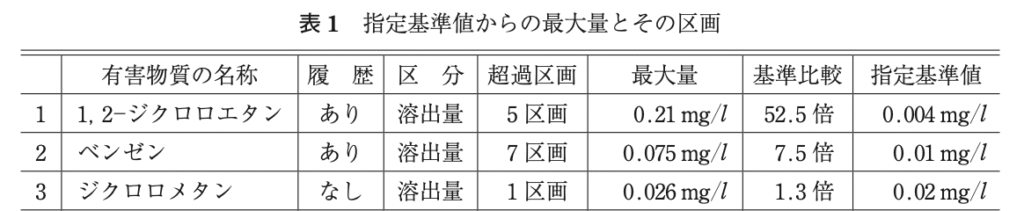
(Image Source: Investigation of VOC Air Pollution Caused by Soil Contamination at Former Chemical Plant Site)
Understanding the Standards: The "Designated Standard Value" is a concentration limit set by the Soil Contamination Countermeasures Act. The Ministry of the Environment establishes these values to prevent health damage from long-term ingestion or exposure via soil or groundwater.
Survey Findings: The investigation revealed concentrations significantly exceeding safety standards:
- 1,2-Dichloroethane: Detected at 52.5 times the standard value.
- Benzene: Detected at 7.5 times the standard value.
These levels indicate a critical state with potential health risks through soil and groundwater exposure.
Solution & Implementation
To address this, we deployed a hybrid system combining our microbubble generation technology, "SepaTech," and our proprietary microbial decomposition technology, "BioTech."
The Mechanism: By combining these two technologies, we efficiently delivered both microorganisms and oxygen to deep well layers, achieving effective in-situ VOC remediation. The microbubbles penetrate fine gaps in the soil. Upon collapse, they generate active oxygen and increase dissolved oxygen concentrations, activating microorganisms and promoting the decomposition of organic matter and VOCs.
Implementation: We introduced our specific microbial strain, ERP KB-12 (highly effective for benzene decomposition), and combined it with oxygen supply via microbubbles. This created a highly efficient decomposition environment.
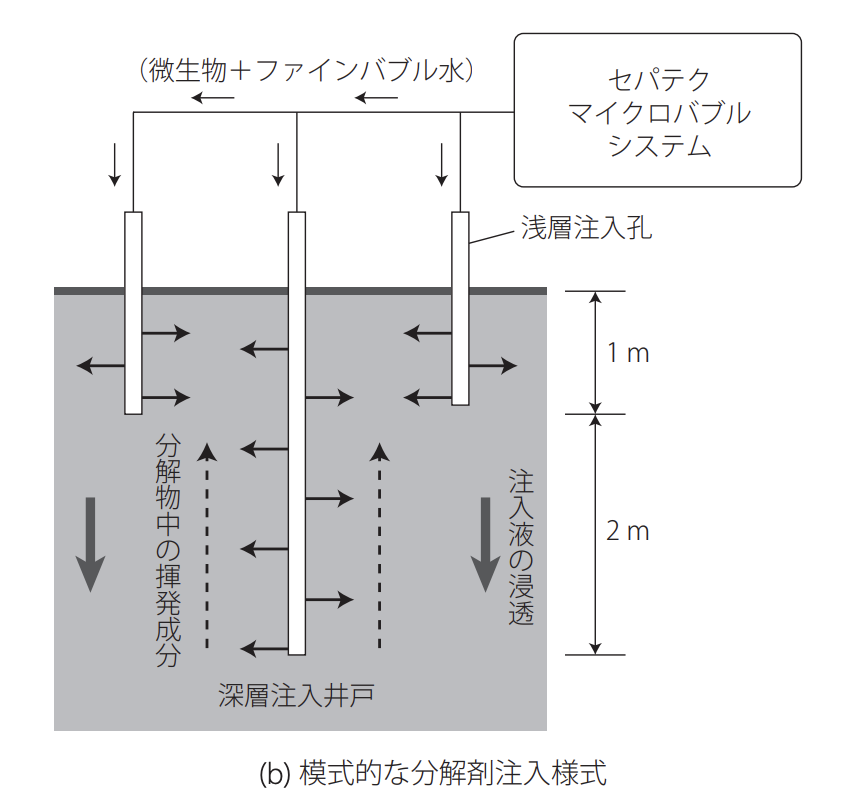
(Image Source: Bioaugmentation for purifying VOCs)
Results & Improvements
Rapid Reduction: In tested sections, odor readings (measured by Shinyei OMX-GR) initially showed values around 960. Within approximately 24 hours, the system successfully reduced these values to nearly 0, achieving irreversible reduction.
Compact & Versatile: The system features a compact design with an integrated bubble generator and liquid pump, allowing for operation in limited spaces such as building basements and tunnels. With its superior workability and versatility, this system is expected to be a highly effective solution for in-situ VOC remediation.