
Overview
We conducted separation experiments on Tritium—a radioactive hydrogen isotope notoriously difficult to remove—using our proprietary SepaTech Microbubble System.
Tests performed on simulated contaminated water demonstrated a reduction in tritium concentration of up to approximately 50% after treatment. This significant result suggests that microbubble technology can physically and chemically separate tritium, offering a promising new approach for radioactive wastewater treatment.
[See more about the technology]
Contents
・The Challenges of Tritium
・Experiment Outline
・Results & Future Outlook
The Challenges of Tritium
Tritium (³H), also known as hydrogen-3, is a radioactive isotope of hydrogen. Because it typically exists as "tritiated water" (HTO) and shares almost identical chemical properties with ordinary water, it is extremely difficult to separate using conventional filtration or adsorption methods.
While the weak beta radiation emitted by tritium does not pose an immediate fatal health risk, the management of treated wastewater from nuclear facilities remains a major societal concern.
As of 2025, no technology has been fully established to completely separate and remove tritium, creating an urgent need for a safe and sustainable solution.
Reference: Ministry of Economy, Trade and Industry, "What is Tritium?"
Experiment Outline
The SepaTech Microbubble System has a proven track record of removing radioactive cesium and volatile organic compounds (VOCs). In this experiment, we treated 5 liters of tritium-contaminated water (raw water) for 30 minutes.
The treated water was analyzed for tritium concentration by the Japan Chemical Analysis Center using a low-background liquid scintillation counter (Hitachi LSC-LB5).
Results & Future Outlook
Analysis confirmed a decrease of 40–50 Bq/L in the treated water, equivalent to a 40–50% reduction compared to the raw water.
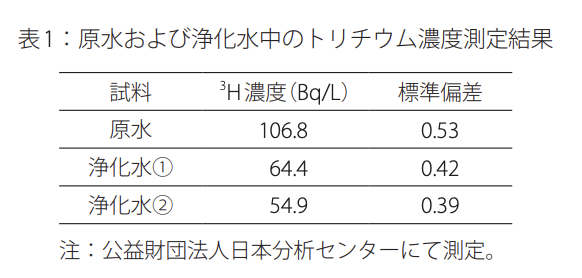
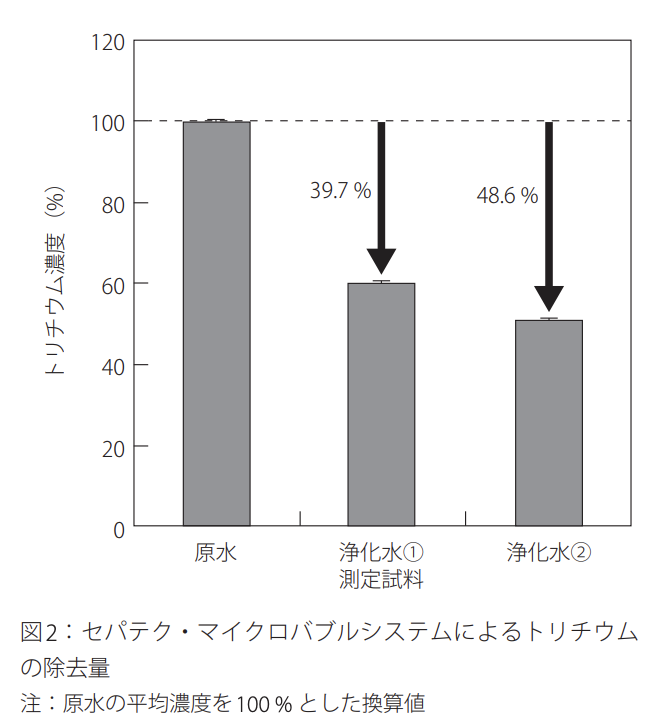
Image Source: Tritium Flotation Separation achieved by SepaTech Microbubbles
These findings suggest that applying multiple cycles of the SepaTech system could reduce tritium levels in stored water, such as that at the Fukushima Daiichi Nuclear Power Plant, to below the Japanese discharge standard (60,000 Bq/L). We are committed to continuing our R&D efforts to establish a highly efficient and practical tritium separation technology.